Small Apartment Balcony Garden Ideas: A Beginner’s Guide to Growing Food
Small balcony? No problem! Follow my expert tips and design ideas to grow an apartment balcony garden filled with herbs, flowers, and greenery.
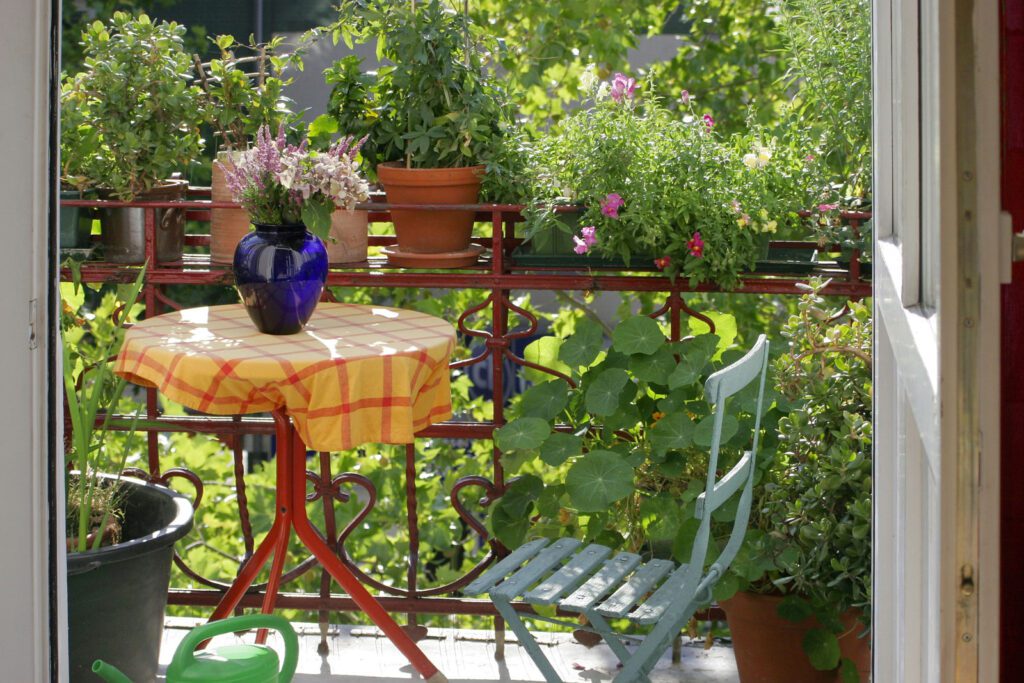
Imagine stepping onto your balcony and picking fresh basil for dinner or harvesting cherry tomatoes for your salad.
You don’t need a backyard to enjoy the satisfaction of growing your own food. Even the smallest apartment balcony can become a beautiful, productive garden filled with fresh herbs, vegetables, edible flowers, and colorful containers.
Whether your balcony gets full sun or just a few hours of morning light, I’ll show you how to create a space that’s both beautiful and productive. In this beginner-friendly guide, you’ll learn how to choose the right plants, containers, and layout so you can grow fresh food with confidence-even in a small space.
In this guide, you will learn:
- How to determine if your balcony is suitable for gardening
- The best plants for sunny and shady balconies
- How to choose the right containers and potting soil
- Easy watering and fertilizing tips
- Simple layout ideas to maximize a small space
- How to grow fresh herbs and vegetables for your kitchen
Throughout this post, I will add links to suggested materials and my favorite products to make your balcony garden experience successful and rewarding. No garden-gatekeeping here!
Ginger with Roots Tip!
Before you buy your first container, check with your landlord or management company about any restrictions for your balcony garden. Potted plants with wet soil can be surprisingly heavy, and some buildings have rules about water drainage or railing planters. A quick conversation now can prevent headaches later!
Before You Start Your Balcony Garden Space
Even though it’s tempting to immediately go buy plants and figure out what to do with them afterwards, take the time first to assess your space properly. If you have a smart phone, grab it now because it will come in handy!
Sunlight Exposure: Which direction does your balcony face? If you don’t know off the top of your head, use the compass on your phone to find out!
Track how many hours of sunlight your balcony receives. This will vary depending on time of year. Also nearby buildings and trees might shade your balcony.
Ginger with Roots Tip!
If you have a Ring camera, use it to monitor the space for 24 hours. Check the history to see when the balcony is in sunlight and when it’s in the shade.
| Light Category | Daily Sunlight Hours | Description |
|---|---|---|
| 🌞 Full Sun | 6–8+ hours | Needs direct sunlight for most of the day; best for open or south-facing balconies. |
| 🌤️ Part Sun | 4–6 hours | Enjoys morning or late afternoon sun; tolerates brief shade. |
| 🌥️ Part Shade | 2–4 hours | Prefers dappled or filtered light, away from strong afternoon sun. |
| 🌑 Full Shade | Less than 2 hours | Thrives in low-light or shaded areas; ideal for north-facing corners. |
Wind Exposure: Does your balcony receive strong breezes? Usually higher floors are more susceptible to wind which can cause a couple of problems for small balcony gardens:
- Wind dries out plants faster and that means more watering.
- Wind also can topple lightweight or tall planters. Plan to secure them if necessary.
Water source: Does your balcony have a spigot? Drip irrigation with a timer can be set up easily for a small apartment balcony garden if there is a spigot. Read my post Easy Step by Step Drip Irrigation for Raised Beds to learn exactly how to equip your balcony with automatic water.
If there is no spigot on your balcony, be prepared to hand-water your plants regularly. I like this particular watering can for its gentle distribution and the fact that you can rotate the spout for different stream effects. Using self-watering plant containers can also help with handling the water demands.
Ginger with Roots Tip!
I’ve found that keeping a watering can (or two!) filled with water on the balcony encourages me to catch dry soil before plants begin to wilt.
I also like to use watering globes for backup watering when out of town like my friend, Cynthia, uses in the photo below. She’s such a wonderful neighbor; she bought me some, too!

Bottom line: Container gardens dry out faster than garden beds in the ground. Therefore, a typical balcony garden will require more water. Add hot sun and wind exposure to the equation and you will be needing even more water. Be prepared!
How to Design a Small Apartment Balcony Garden
This might seem obvious, but you would be surprised how many beginner gardeners skip this step. We are all guilty of it: “envision a lush Instagram-worthy garden, buy as many plants and containers as possible and then put them all out on the balcony willy nilly.” And then what? IT FAILS.
Try this instead: Ask yourself what you want to achieve and make a plan!
Measure and Take Pictures
Trust me, this will be so handy when you finally get to the plant store and start buying materials.
- Take pictures from various angles and add them to an album or “Notes” folder on your smart phone.
- Measure and save the dimensions of your balcony dimensions.
- Measure the width and depth of your railing if you plan to add railing planters.
Decide Your Goal
Organize your expectations by drilling down on what you want to achieve.
1. Your Garden Vision
- What inspires you to start your balcony garden?
☐ Fresh food ☐ Beautiful space ☐ Stress relief ☐ Sustainability ☐ Other: _______ - How will you use your balcony?
☐ Quiet retreat ☐ Mini farm ☐ Entertainment space ☐ Decorative display - What’s your main goal?
☐ Look beautiful ☐ Feed me ☐ Feel calming ☐ Attract wildlife
2. Lifestyle & Care
- Time per week: ☐ <1 hr ☐ 1–3 hrs ☐ 4–6 hrs ☐ Daily care
- How often are you home to water? ☐ Daily ☐ Few days ☐ Weekends only
- Garden type: ☐ Seasonal change ☐ Evergreen (plant it and forget it)
3. Space & Function
- Balcony size: ☐ Small ☐ Medium ☐ Large
- Features: ☐ Seating ☐ Vertical planters ☐ Shade ☐ Lighting ☐ Other: _______
- Shared space? ☐ Yes ☐ No
- Multi-purpose? ☐ Yes ☐ No → If yes: ___________________________
4. Style & Mood
- Style: ☐ Lush ☐ Modern ☐ Rustic ☐ Bright ☐ Other: _______
- Plants: ☐ Edibles ☐ Flowers ☐ Succulents ☐ Fragrant ☐ Pollinator
- Theme: ☐ Cozy ☐ Mediterranean ☐ Tropical ☐ Cottage ☐ Zen
5. Reflection
Summarize what you learned:
- My garden will primarily be: ____________________________
- The mood I want to create is: ____________________________
- My top priorities are: ____________________________
Create Zones for Your Layout
I love this part! This is where you design the framework of your garden. We will get to the plants next!
Define your areas or zones for your balcony. These might include:
- Container garden
- Sitting area
- Greenery for privacy
- Small potting bench or space for watering can, gloves, and supplies
- Vertical garden for herbs, veggies or flowers
Maximize Vertical Space
When dealing with a small balcony space, height is your best friend! Instead of putting containers exclusively on the ground, make sure you are taking advantage of the middle area.
Make use of:
- Railings
- Window boxes
- Tiered plant stands
- Tower gardens
- Table tops
Now keep going higher and really maximize your space. Think about:
- Hanging plants
- Trellises
- Wall mounted plants (given permission of course!)
- Arbors anchored in soil filled pots.
These all allow you to have more plants and build height at the same time.
Garden Tower Project has a line of vertical tower gardens with built-in composting systems AND they are on wheels-great for small space gardening.
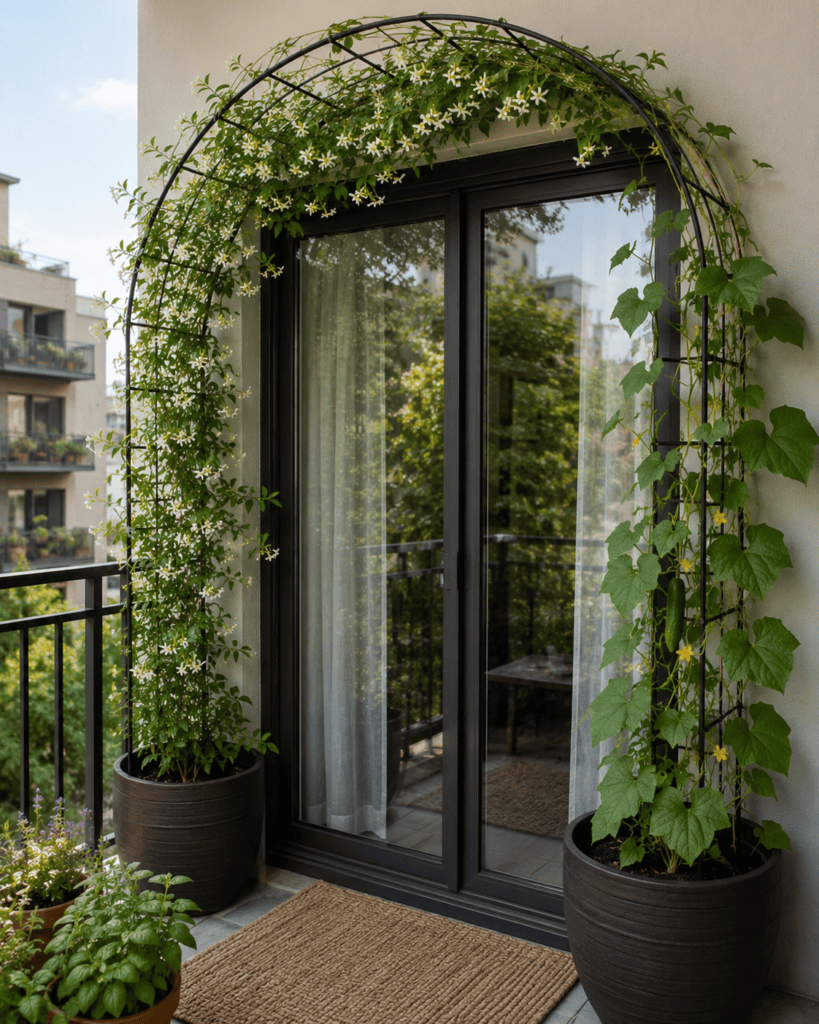
Don’t forget your climbers. A metal arbor placed in front of sliding doors and ‘anchored’ in soil filled pots can allow you to train flowering or fruiting vines on your balcony without drilling holes into the exterior walls.
Best Containers for Balcony Gardens
When choosing planters, remember these tips:
- Small containers dry out faster than large ones.
- The container needs to be large enough for your plant’s mature root depth.
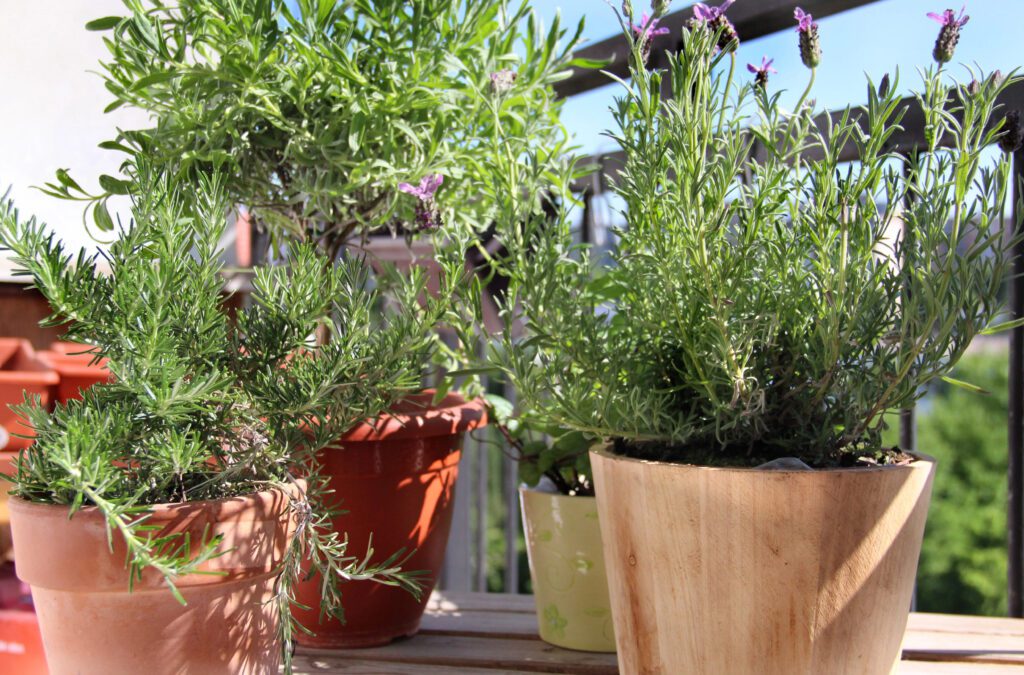
- Terracotta pots are porous which dry out faster and can crack in freezing temps.
- All containers need drainage holes-many decorative ceramic ones don’t have one!
- Try fabric Grow Bags that are lightweight and fold flat for easy storage later.
- Use rolling plant caddies for easy maneuvering on a balcony and to keep containers up off the ground for better drainage and for preventing plant stains from dirt, etc.
- Use planter insulators to wrap pots in freezing temps, if necessary.
Regardless of your balcony garden’s purpose, keeping it aesthetically pleasing will encourage you to spend time in it. I recommend a cohesive look for your containers. For example, if your climate permits and you have ample water supply, using all terracotta pots of different sizes will look amazing.
Want some inspiration? Read my post DIY Hanging Herb Garden to see how I made a self-watering herb garden for our deck.
Going for a Boho vibe? Try mixing and matching various natural materials like basketry, macrame, and terracotta. Accent with twinkle lights and colorful seating pillows.
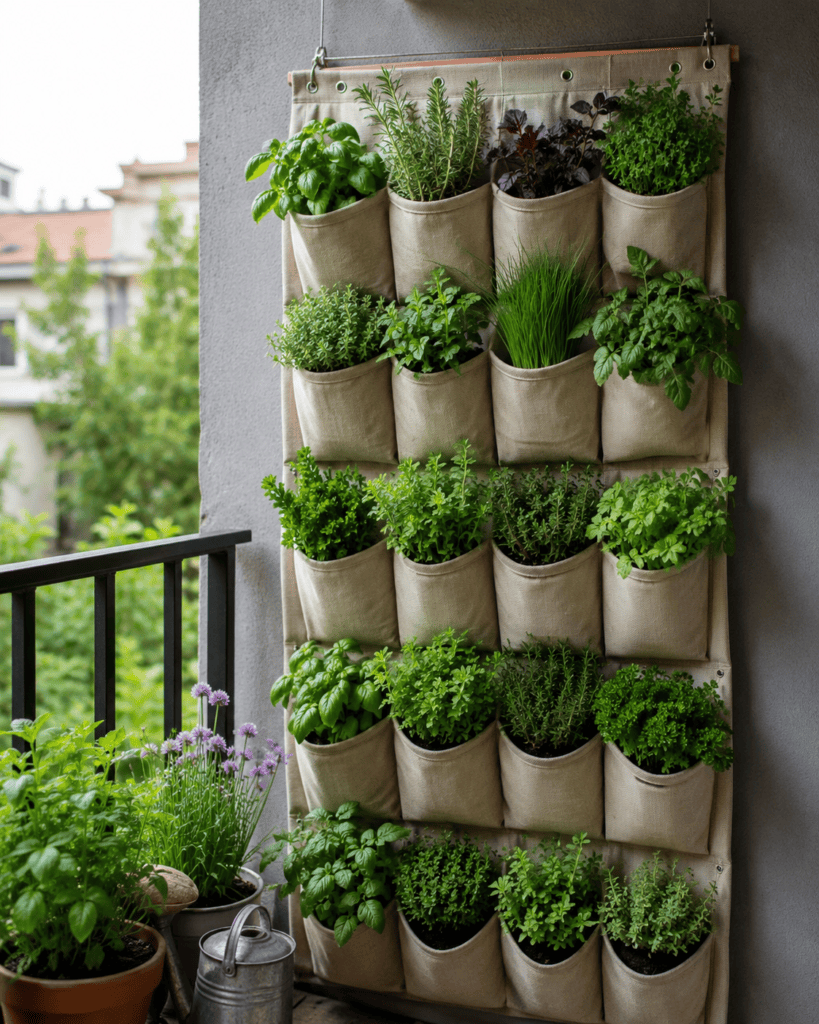
I saw a fellow gardener who turned a fabric hanging shoe organizer into a wall pocket garden. Since I couldn’t get a photo, I asked ChatGPT to create one for me. Isn’t this clever?
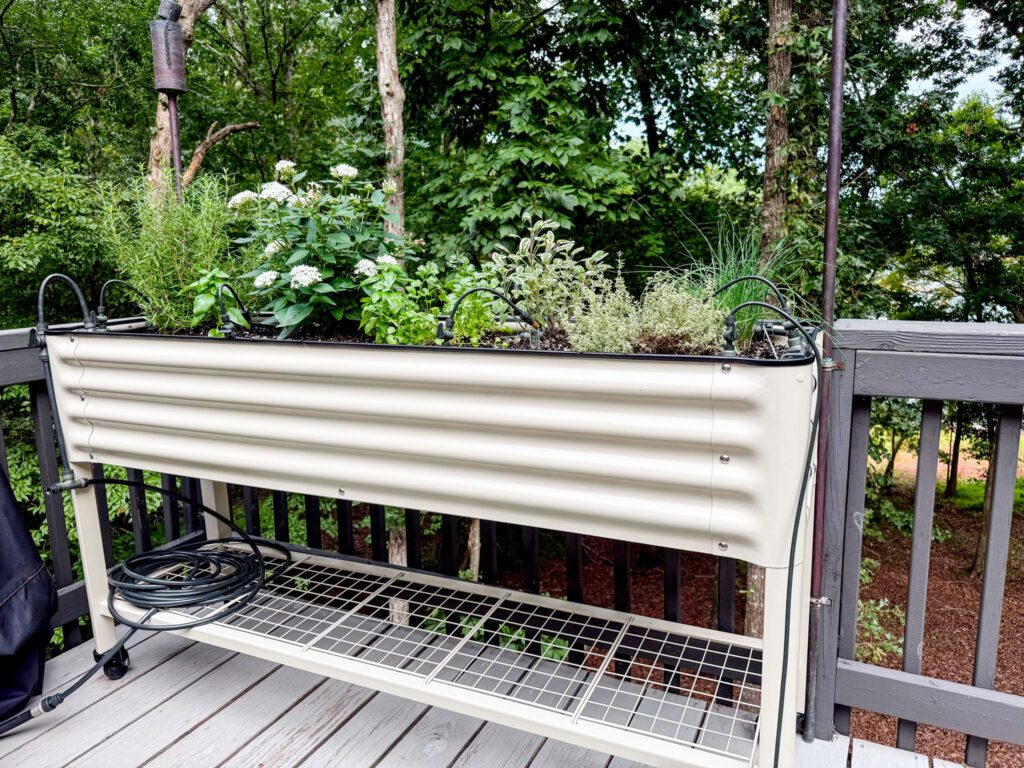
Need durable yet attractive containers for edible plants? I love love love my Vego beds. Consider their deck friendly items like this raised bed with wheels and storage shelf.
Or if you needed some added privacy, this Vego planter with attachable trellises is perfect!
For seating on a small apartment balcony garden, this metal bistro set fits nicely! I have two of them and love their durability. Bonus: I’m able to move them around by myself!
What Can You Grow on a Small Apartment Balcony?
This might be the most frequently asked question, and the answers will help you narrow down exactly how to design your balcony garden.
Best Vegetables for an Apartment Balcony
- Tomatoes (determinate, not indeterminate; cherry tomatoes; use cages/stakes)
- Peppers (use tomato cages/stakes to support them)
- Lettuce or Arugula (remove leaves as needed for steady supply)
- Kale (one spring plant can last well into summer)
- Green beans (bush bean variety like Jade for small space and maximum production)
- Cucumbers (bush varieties like Spacesaver 80)
- Radishes (start from seed)
- Carrots (start from seeds in deep pots-at least 12-18″)
- Swiss chard
Ginger with Roots Tip!
Choose vegetables your family actually enjoys eating. A few productive crops you’ll use every week are more rewarding than growing something that sits in the refrigerator.
Best Herbs to Grow on a Balcony
- Basil
- Parsley
- Chives
- Thyme
- Rosemary
- Sage
- Mint (always in its own pot!)
- Oregano (also always in its own pot)
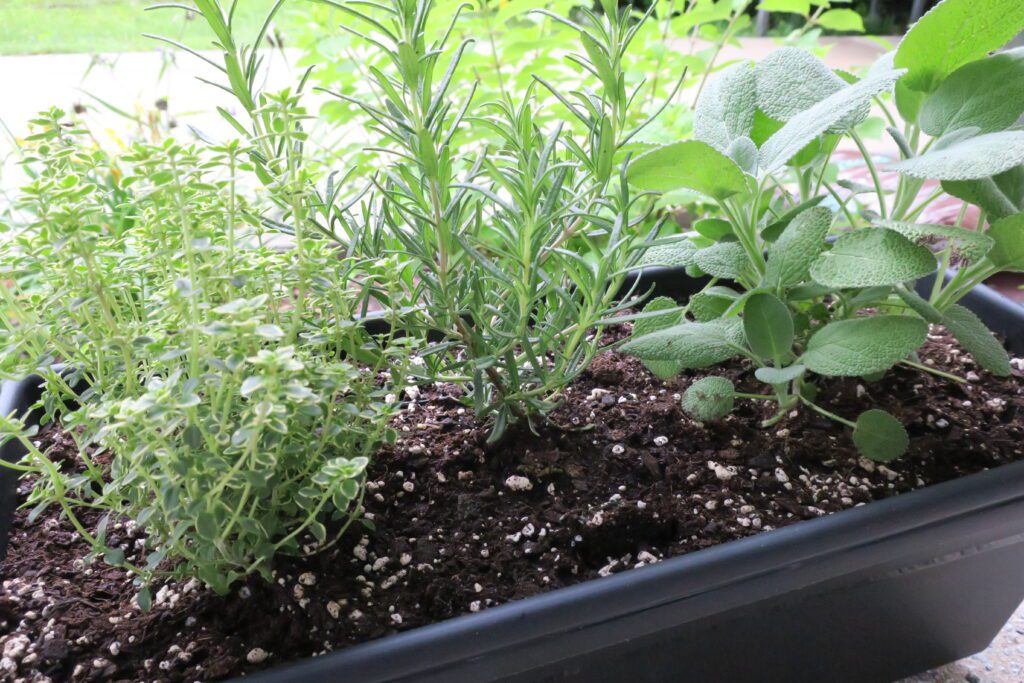
If grouping in containers, put rosemary, sage and thyme together. They are woody herbs and have same growing conditions. Tender ones like basil, chives and parsley can go together. Keep oregano and mint in their own space-they like to spread!
Best Flowers for a Balcony Garden
I’m choosing these flowers for two reasons. First several are edible and will go nicely with your herbs and veggies. Second, they attract pollinators and beneficial insects which helps support your food production.
- Nasturtiums (edible)
- Marigolds
- Calendula (edible)
- Petunias
- Zinnias
- Alyssum
- Lavender (culinary variety)
Be sure to look at this easy Small Space, Big Harvest Seed Bundle perfect for small balcony gardens!
How to Plant Your Balcony Garden
It’s time to plant your balcony garden-woohoo! We’ve covered sunlight, watering needs, container choices and space layout.
Choosing plants and decorative items is an artistic and satisfying task. It’s the fun part, right?
What words come to mind when I say choose your soil? Boring? Confusing? Empty thought bubbles? No worries- we got this covered, too.

What to consider when choosing soil for balcony gardens:
- Avoid regular garden soil that will compact in a container and distress the plant’s roots. Save that for in-ground gardening!
- Look for lightweight potting mix which has a perlite mixture. Perlite is a white volcanic glass and looks like tiny styrofoam balls in the soil. It helps with aeration and moisture control.
- Tropical plants require soil that has a good mix of potting soil, coco coir, orchid bark and compost to imitate the jungle floor.
The key here is drainage. If your container holds too much water, your plant will essentially drown. The roots will rot. The leaves will yellow. Fungus will set in and the show is over. Make sure your container has drainage holes and your soil has perlite.
When it comes to soil, I am a true believer in Fox Farms. I’ve never had a problem with Fox Farms and use both Ocean Forest Potting Soil and Happy Frog Potting Soil.

Ginger with Roots Tip!
Place coffee filters over the drainage holes to allow water to drain, but prevent soil from running out the bottom.
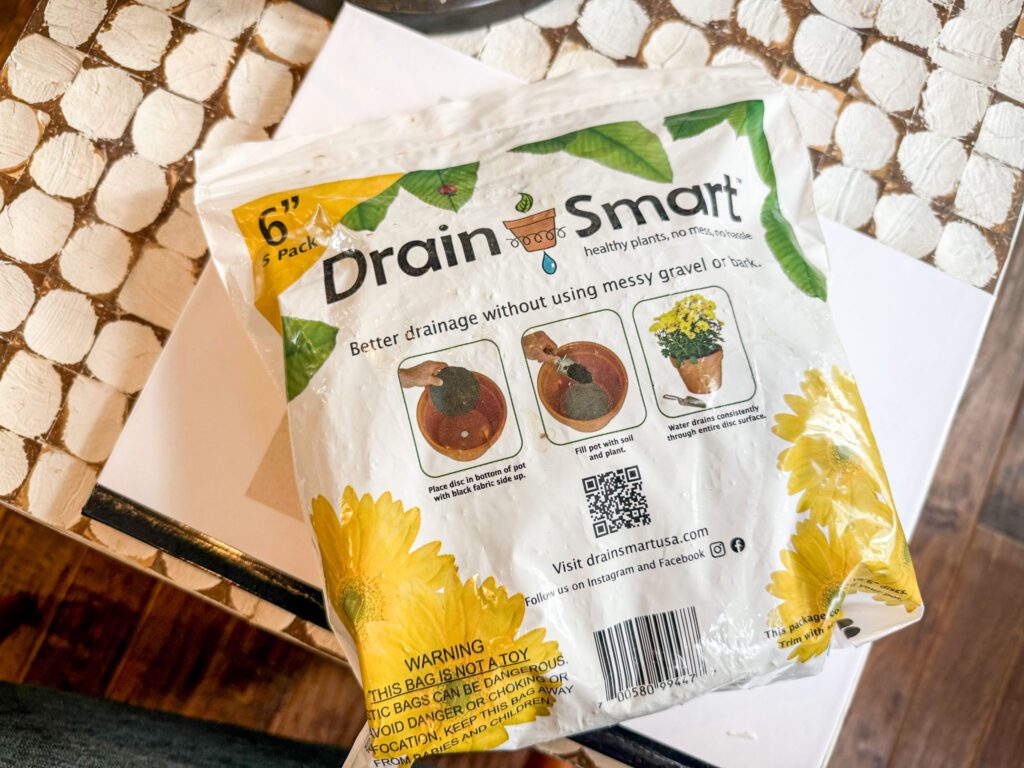
I’ve also used these drainage hole screens in the past and found them to be very effective!
See all of the dirt on the deck boards? You don’t want that on your balcony or in your apartment. Take my advice and grab one of these handy Plant Mats that help contain the excess soil. It’s a game changer for planting and repotting without the mess! You will thank me!

Caring for Your Balcony Garden
First and foremost, water your balcony garden judiciously. This is why I suggested figuring out your water source back at the beginning of this post. It’s okay if you want to scroll back up and reread that part 🙂
Suggestions for Watering
For flowers and vegetables (not succulents!) start with a once a week watering schedule and adjust as needed. Full sun locations will require more frequent watering, like 2-3 times a week and even more if there’s a heat wave!
Check the soil moisture level with a moisture meter or use your finger. If the top inch of soil is damp, put the hose down. If it’s dry, water it!
Water containers deeply-until it runs out the drainage holes.
Keep a watering can in plain sight to help you remember!
Choosing and Using Fertilizer
I cannot stress this enough: feed your plants! Water is running through these pots like crazy and taking nutrients with it. Your container plants will be hungry and need lots of fertilizer.
Fertilizer can be a bit confusing. However, if you’re curious about the three numbers on a bag of fertilizer, they represent the three components N-P-K or nitrogen, phosphorus and potassium. I wish potassium was called kotassium so I could remember it more easily!
In my chart below, I suggested the fertilizer 10-10-10 because it’s a good balanced blend. However, you can find products with various amounts/ratios suitable for your plants’ needs.
Save this chart to your phone so can refer to it when looking for fertilizer!

My feeding routine is a 2-step process:
- Add a slow-release fertilizer to the soil at the time of planting. I like Gardenwise 10-10-10 Fertilizer for most of my container gardens. It looks like small fish eggs that you sprinkle over the soil surface, and a little bit of fertilizer is released each time you water.
- Every 2-3 weeks, use a liquid fertilizer. Follow the directions on the packaging for accurate measurements. I repurpose gallon sized milk jugs for easy mixing. Again, Fox Farms has wonderful organic liquid fertilizers that come in concentrate form. This Fox Farm Fertilizer Trio is perfect for feeding your plants at different stages of development.
Ginger with Roots Tip!
Gardening is all about trial and error. Observe your plant’s appearance to determine if you need to adjust your water/food schedule.
Keep in mind that your garden will require extensive feeding and watering during the growing season. If you live in a climate with a dormant season, you will need to back off your schedule to prevent damage to tender new growth.
Looking for more specific ideas? Read Spring into Summer Container Garden: Tips and Recipes where I teach you how to use the Thriller, Filler and Spiller method.

Interested in a “One Plant, One Pot” design instead? Read The Quiet Beauty of the Single Plant Containers perfect for small apartment balcony garden.

Common Balcony Garden Mistakes and Problems
Gardening isn’t about perfection. We learn through experience and making mistakes. That’s okay!
Let the plants show you what they want.
- Droopy leaves? Try repositioning the pot to a spot with less wind or adjusting the amount of water.
- Yellow leaves? You might be overwatering. Is the pot draining like it should? Does it need nitrogen?
- Bugs nibbling? Identify the pest and deal with them using Neem oil or good old handpicking.
- Slowed production? Deadhead spent blossoms and remove debris from the balcony routinely to keep plants producing and to maintain an inviting tidy space.
Harvest Fresh Food From Your Balcony
Deadheading isn’t just about removing dead flower blossoms for a nice appearance. It tells the plant to keep going! The same holds true for fresh herbs and vegetables.
Are you still imagining that fresh basil in your garden? Get your clippers ready! Frequent snips will keep it from forming flowers and then seeds and then retiring from the basil business completely. Enjoy the smell of fresh basil and bring your rewards into the kitchen by harvesting often.
Read my post Homemade Basil Pesto for detailed information about growing, harvesting and using homegrown basil.
Are you growing kale or arugula in the cooler seasons? Read my recent guides How to Grow Kale and Three Easy Ways to Use it in the Kitchen and How to Grow Arugula: Simple Garden to Table Recipes for more in depth knowledge.
I’m always adding more garden to table guides perfect for small space gardens. Join my Facebook Group “Grow, Cook & Eat!” for up to date posts and to share your experiences with the rest of us.
Enjoy your garden!
Make time to relax and enjoy your special spot. City life has an energy that is exciting and adventurous. However, it’s also draining. Nourish your mind and body with the health benefits of gardening.
Studies show that simply LOOKING at a garden helps lower blood pressure and encourage healing. Smell the fragrances of your flowers, cook with your herbs, or read a book under the leaves of your privacy screen! You deserve it!
Did you make a design for your small apartment balcony garden? How did it turn out? Please leave a comment below!
For more suggestions read Cozy Porch Ideas where I detail how to make a porch feel cozy.
Read The Homegrown Gardener’s Guide: Growing, Cooking, and Living with the Seasons.



This guide is super helpful! This is a game changer for someone who wants to start small-space gardening.” Thanks for the detailed tips!”