How to Start a Simple Garden Journal that You Actually Use!
Learn how to choose the right journal for you, how to set it up and how to keep it going so that it provides you with helpful information (and a few laughs) for years to come.
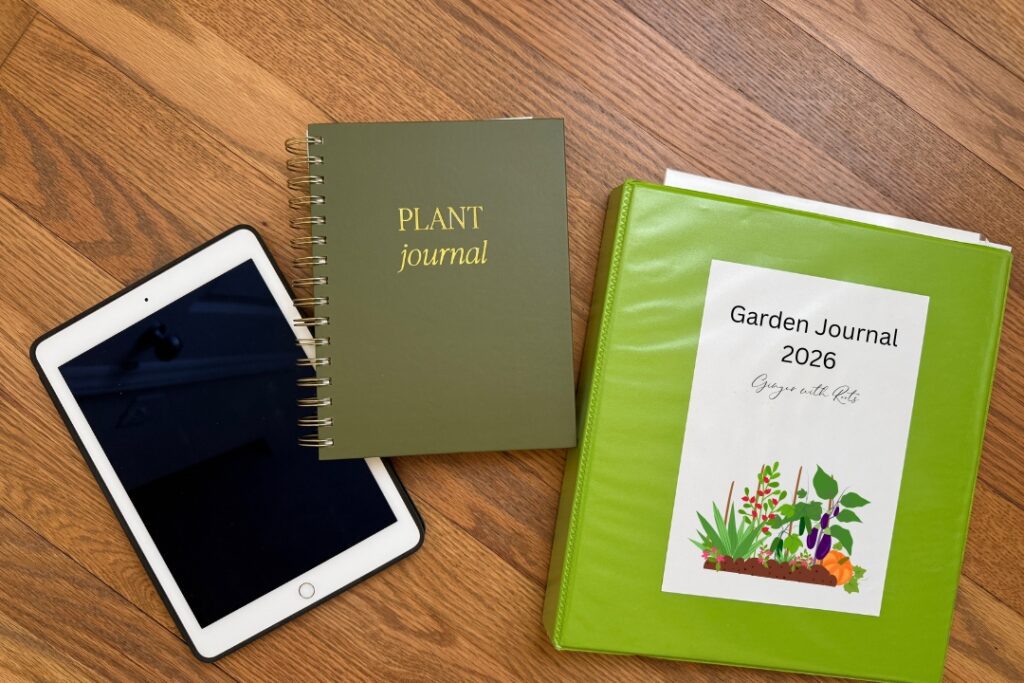
Whether you’re a new gardener or a seasoned one that never took the time (me!), now is the time to start a simple garden journal that you actually use. Together we are going to break down this wall and utilize one of the most important garden tools we have-a journal!
I am including a free pdf download at the end of this post filled with prompt suggestions for your journal!
Garden Journal or Garden Planner?
If you signed up as one of my subscribers, you probably received your free 40 page Garden Planner and have it in your downloads. If you haven’t subscribed, please do so and get your free pages!
Like most people, I use the terms garden journal and garden planner interchangeably. However, there is a slight difference between them.
- The garden planner is for planning. It’s for the future. What are you planting this season? What is on your wish list? What changes do you want to make? What is my new raised bed layout? Where can I put my dream greenhouse?
- The garden journal is for record keeping. It’s for the past. What happened in the garden? What ate my lettuce? Did this flower die from too much sun or pests?
We actually need both types, and I think most gardeners tend to blend them together. For our purposes, we are focusing on making a simple garden journal. Don’t worry; you can use some of the free downloads I provided for the journal, too!
Choose the Right Garden Journal for You
When it comes to garden journals, let’s look at three basic formats:
- the spiral notebook
- the 3 ring binder
- the digital platform
As a former teacher, I fully understand that we all learn and process information differently.
Are you auditory or visual? Personally, I can’t stand verbal directions! But if you write them down, I’m good!
Are you artistic? Would you rather trace a picture of a flower or draw it freehand from memory? Or simply take a photo?
Are you data-driven and good with spreadsheets? Or are you creative and reflective?
The type of journal you choose should be structured for you. Otherwise it will probably end up unused and worthless. So take the time now to really think about how you think and how you organize your thoughts.
If I placed in front of you a spiral notebook, a 3 ring binder and a smart phone, which one would you want to use to record your information?
Perhaps use a spiral notebook for the garden journal and keep it inside a 3-ring binder garden planner.
Bottom line: choose the garden journal that feels simple and easy to use for you.
What to Include in a Garden Journal

Page One: Basic Information for Your Location
The very first page in your garden journal needs to include the basic information that every gardener should know about their garden.
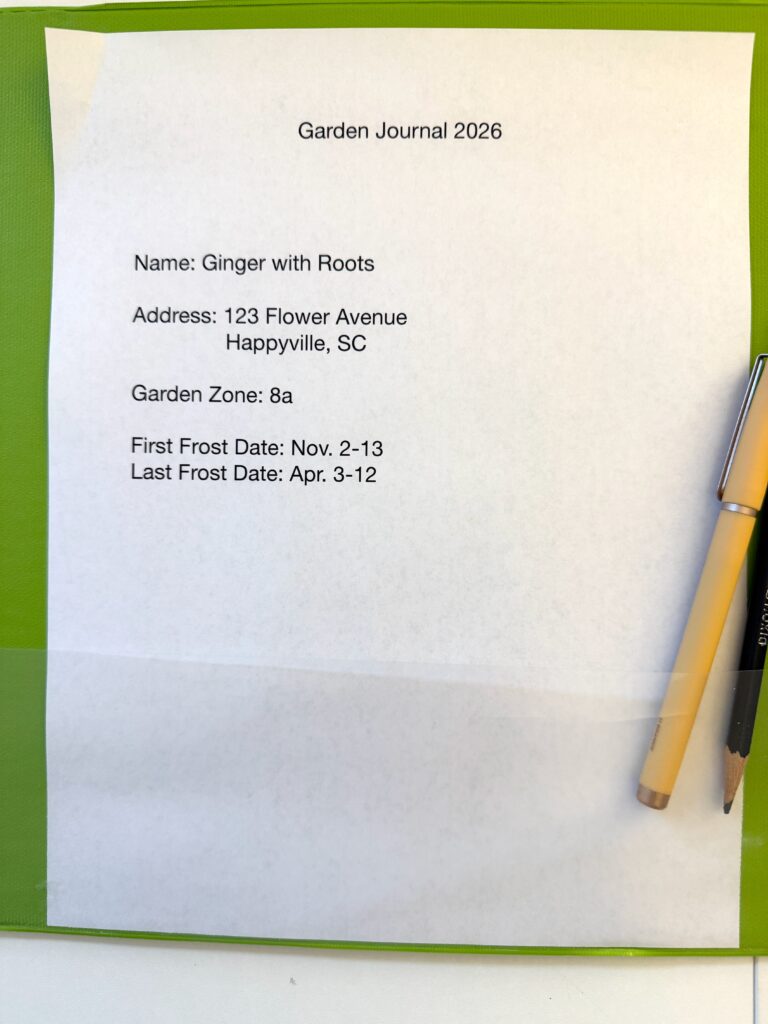
- Your Address. If you move, you can either bring it with you for future reference or leave it for the new homeowners. Either way, the reader needs to know where this is taking place.
- Your Growing or Gardening Zone. Find it here on the USDA Hardiness Zone website. Every plant/seed you purchase will have a zone range. Know yours. Write it down. Memorize it.
- Your First Frost Date and Your Last Frost Date. These dates are based on probabilities, not magical set-in-stone dates. Look up yours here at the National Gardening Association to determine the safest range for frost free growing and write it down.
Page Two: A Simple Garden Map
The next page should be a garden map with the current date. Since our gardens change and evolve over time, this first map should reflect structurally what it is right now. This is not the planner! That’s for later.

- Many gardeners sketch a basic layout using a pencil. Depending upon your level of artistic ability, colored pencils will add depth and clarity to your garden map.
- If freehand drawing is difficult, try these Mr. Pen Landscape Templates that help you draw everything to scale. Measure your garden space; use the 1/4″ to 1′ guide to draw perimeters and then fill in with the tool.
- Even easier? Go to Google maps, pull up your location and screenshot the aerial view. Either print it or save it to a digital journal.
- Use a smart phone/camera and take photos of your garden.
- Use a drone to take aerial photos
This might require more than one page depending on the size of your garden(s).
I chose to use a 3 ring binder and draw my map on graph paper.
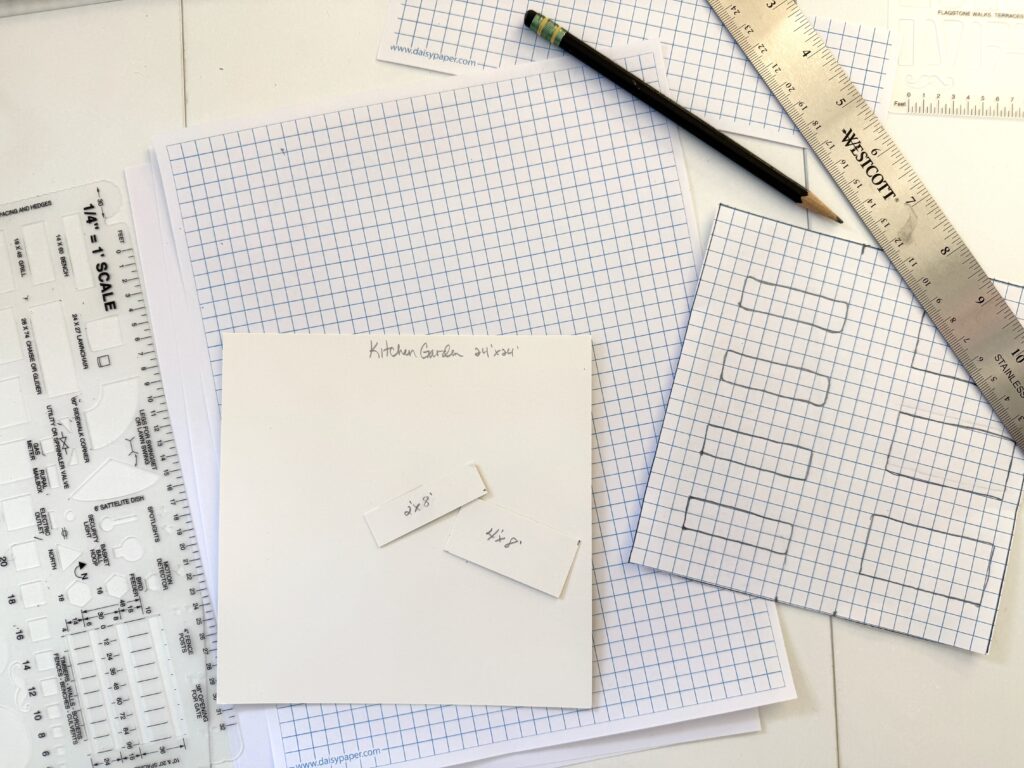
After measuring my kitchen garden at 24 feet by 24 feet, I divided that by four because my graph paper and Mr. Pen templates are 1/4″ scale. This means each square equals one foot. So my garden drawing is 6 inches by 6 inches.
I kept making mistakes on the graph paper and redoing the map until I realized this was not feeling SIMPLE anymore. I could have just drawn it freehand on the graph paper, but I am a perfectionist and decided to try something different.
Therefore, I cut a 6″x6″ square out of some leftover card-stock. I also cut out my raised bed sizes (2’x8′ and 4’x8′) from the card stock to be used as reusable templates of my own!
The card stock templates made it faster to redraw and will make future maps for different seasons and my garden planner easier to do.
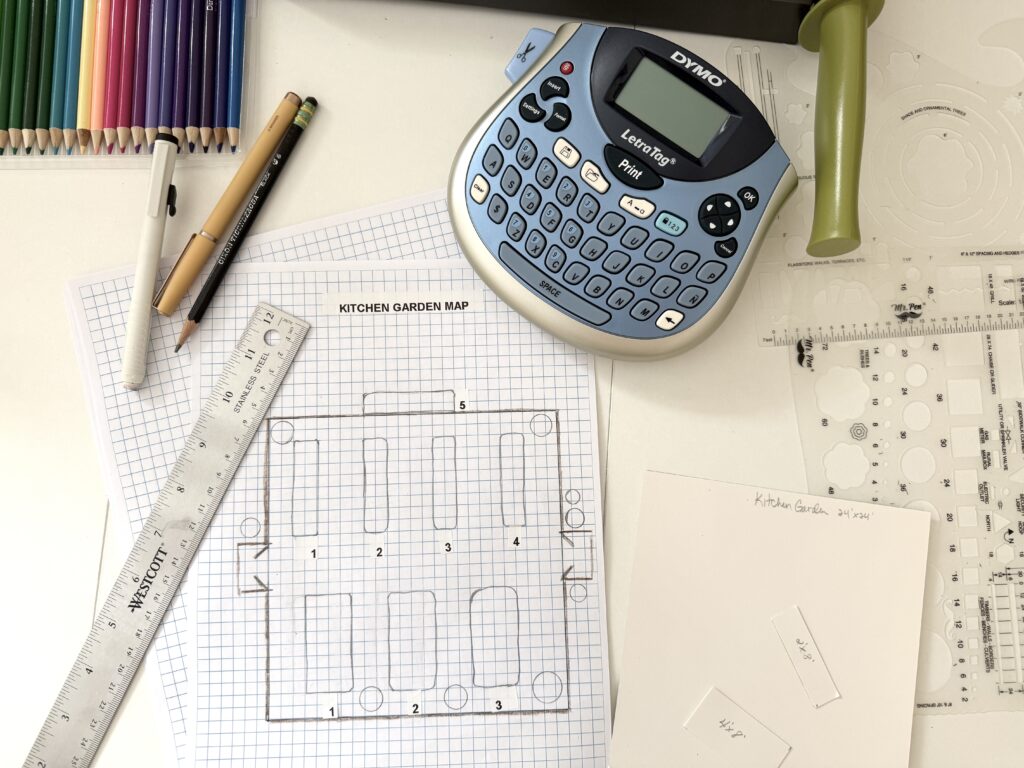
I also used my handy dandy Dymo Label Maker to make my map look neater than my handwriting does. If you don’t have one, I find mine extremely useful for labeling seed storage containers, journal and planner pages and more!
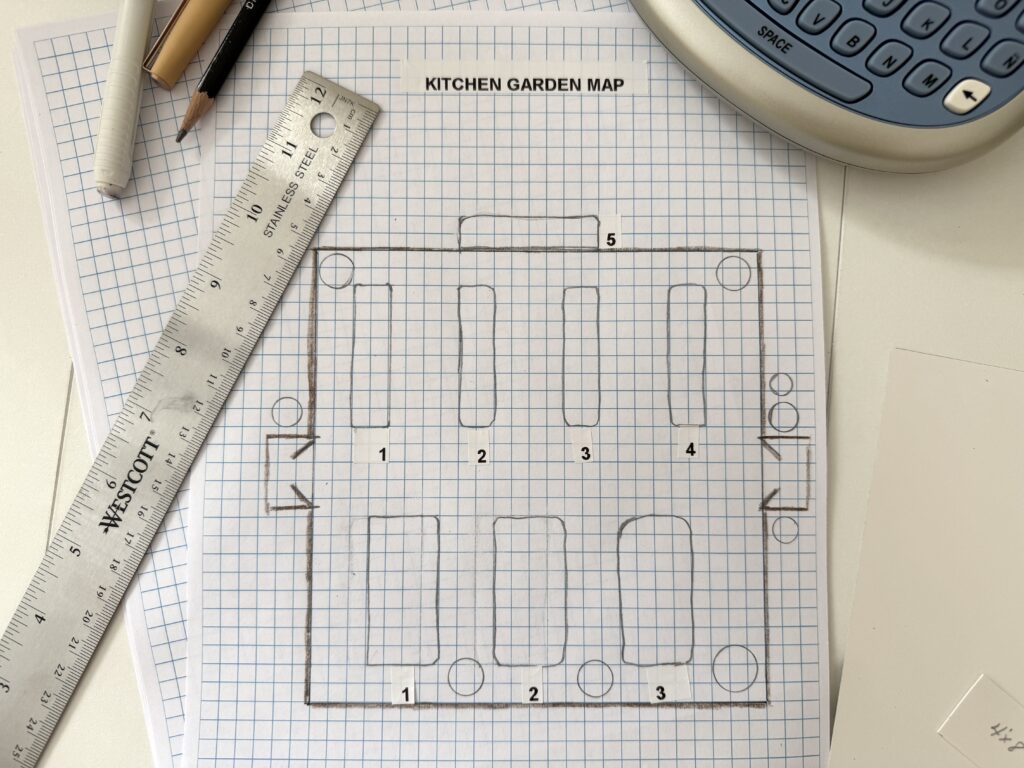
You can see here that I have 5 raised beds that are 2’x8′ and 3 that are 4’x8′ in my kitchen garden. There are also several round containers placed around the garden. Okay, technically raised bed #5 is outside the fenced area, but that’s not important. I told you I was a perfectionist!
Ginger Tip!
Once you have a complete garden map, make several copies of it to use for a future garden planner and sun mapping activities.
Remember the key word here is SIMPLE. Do what works best for your comfort level and enjoyment.
Page Three: A Sun Map
One of the most important steps in being a successful gardener is understanding and working with your sunlight. If you signed up for my 5 Days to Become a Better Gardener Series, you have already learned how to complete a sun map. Congratulations!
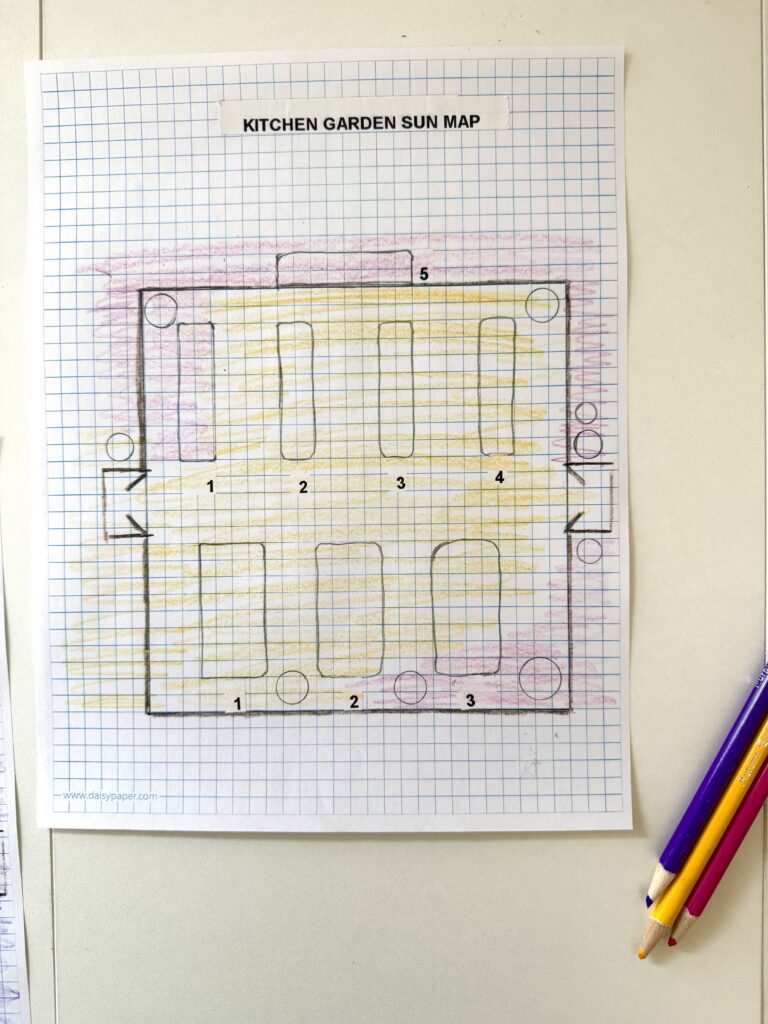
If this is your first time, you will want to track your sunlight for one full day and record your findings. Ideally this occurs on a sunny summer day. If you’re setting up your journal in a different season, do the best you can to determine areas of sunlight/shade by looking at photos from past years.
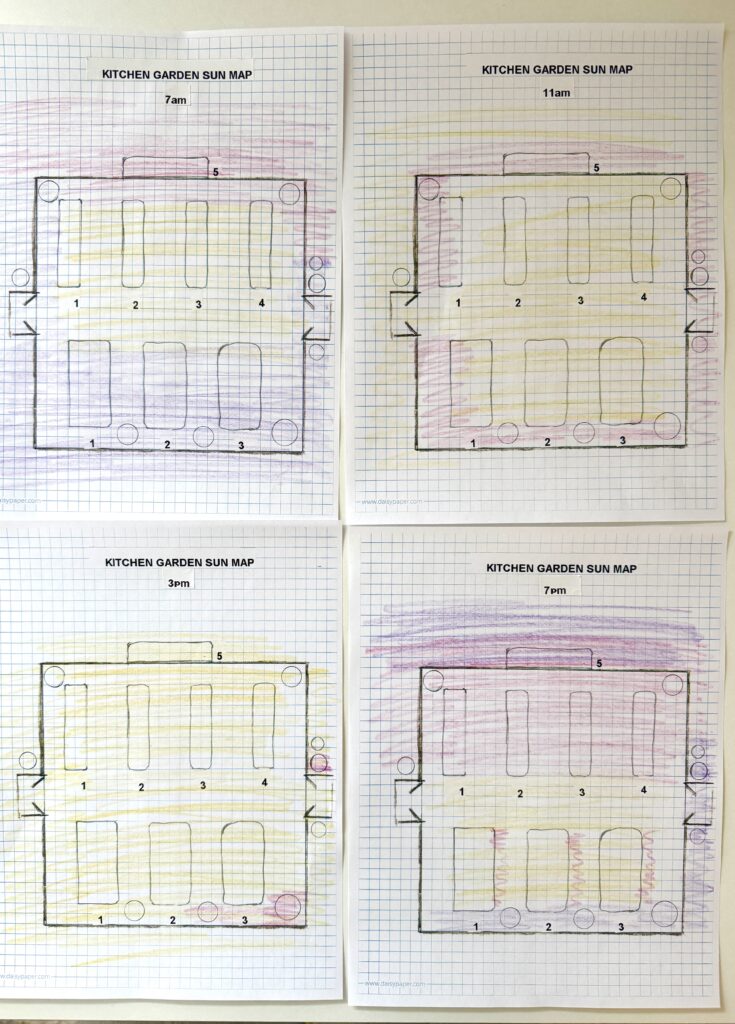
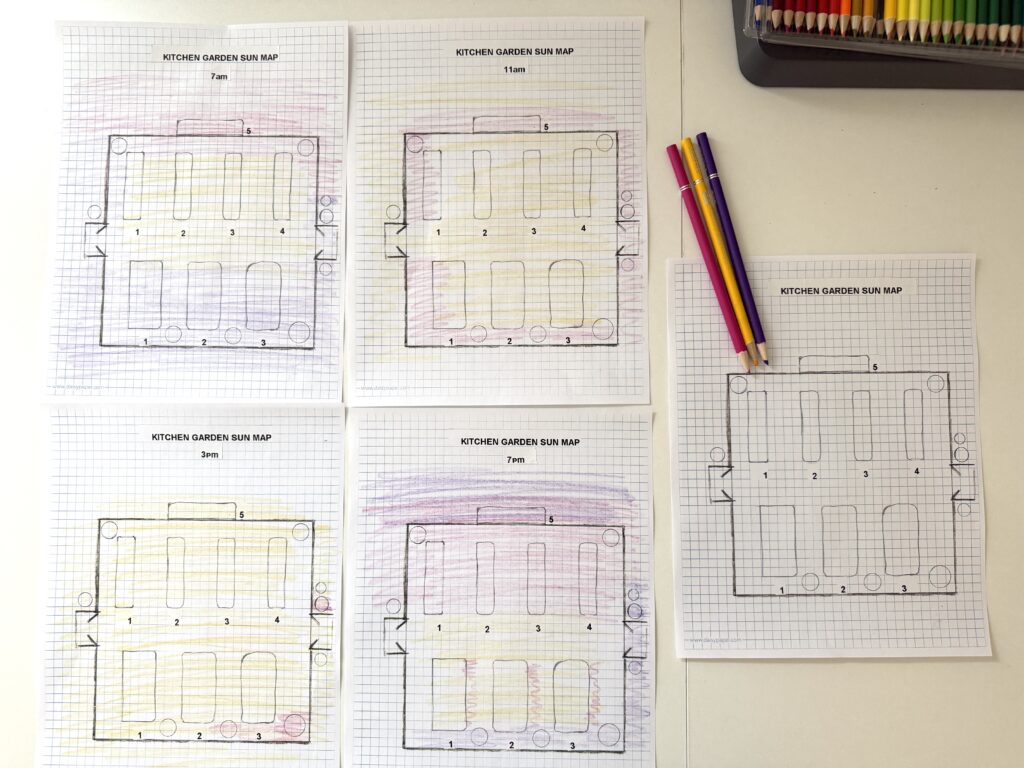
Make 5 copies of your garden map to complete for your sun mapping activity. Grab three different colored pencils and a timer/alarm.
Four times a day (7am, 11am, 3pm, 7pm) note the areas of sunlight and shade on your garden map copies. Use your 3 different colored pencils and lightly shade corresponding light values. I chose yellow, pink and purple.
- Full Sun yellow
- Part Sun/Shade pink
- Full Shade purple
After all 4 copies are colored, use the 5th copy to make one that shows the full day’s exposure. If an area is full sun for 2 or more maps, mark that area as full sun. Do the same for part sun/shade and for the full shade areas. The 5th copy will be your sun map that goes in your garden journal.
- Full Sun: 6+ hours (yellow)
- Part Sun/Shade: 3-6 hours (pink)
- Full Shade: less than 3 hours (purple)
There are other variations of sun mapping out there, but this should give you a pretty good idea.
Google Earth Pro allows you to look at aerial views on specific dates of satellite images. You can try using that as a backup to create a general sun map and then fill in more accurately later.
The Remaining Pages: Journal Entries
This is the fun part and the meat of your journal. Think of it like a diary for your garden. Record your observations, notes and feelings about the garden on a daily or weekly basis (or simply whenever you feel like it!).
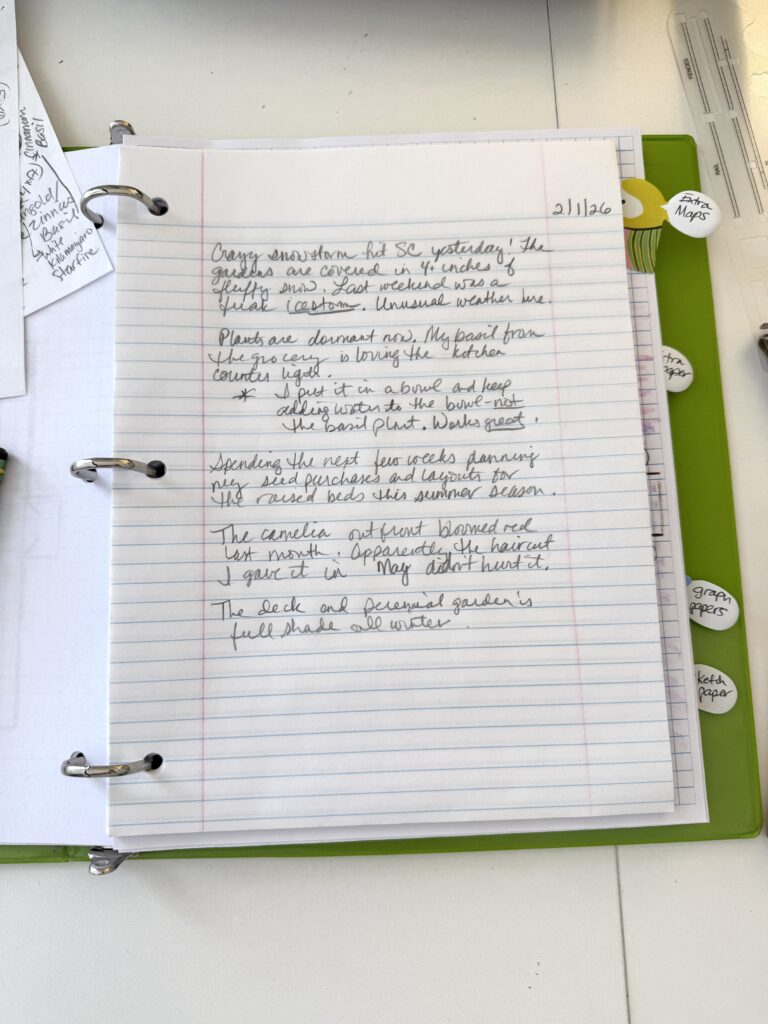
Some ideas to record in your simple garden journal include:
- Seed starting dates
- Planting dates
- Varieties planted
- Weather notes especially strange or extreme instances
- Watering issues
- Fertilizer dates and amounts
- Soil amendments added and dates
- Pests in the garden; treatment
- Diseases in the garden; treatment
- Plant growth and changes toward maturity
- Harvest dates and yields
- What’s working
- What’s not working
- Special moments that are funny, meaningful or maybe sad.
You are in charge. You can be as scientific or as poetic as you want to be with your journal.
I also included a free pdf download at the end of this post filled with prompt suggestions for your journal!
How Often Should You Use Your Journal?
Again, this is your project. Do what feels comfortable and manageable for you. Obviously, the more you include, the more valuable your journal will be in future years. But if it becomes a bothersome chore, you might avoid recording much at all. So keep it simple and doable.
Be flexible and aim to record observations at least once a week and more often during peak growing season.
Feel free to jot quick notes instead of long entries. No one is grading this! Mispeled words and sentence fragments are
(See what I did there? It was uncomfortable for me, too).
Keys to a Successful Garden Journal
In order to set yourself up for success, focus on accessibility and creating a routine.
Location
Keep your garden journal and a pencil in a location where you will use it consistently. Is that in the shed? garage? kitchen? bedside table? on your phone?
Materials
Make sure you have a pen or pencil with it at all times as well if you are writing and sketching.
Keep paper supplies on hand like graph paper, blank paper and lined paper.
Keep a three hole punch nearby if you are using a binder.
Pre-printed Pages and Prompts
Again, subscribers have access to 40 pages of free printables to use.
I also included a free pdf download at the end of this post filled with prompt suggestions for your journal!
Some simple prompt ideas just for you:
Quick One-Line Prompts (Perfect for Busy Days)
- Today’s garden win:
- One thing I noticed:
- One thing I learned:
- One thing I’ll do differently next time:
Mistakes to Avoid
Just like gardening, there will be challenges with keeping a simple garden journal. Avoid these common mistakes:
- Trying to track too much at once
- Skipping or stopping entries altogether just because you “missed a day”
- Comparing your journal to others
- Overcomplicating your journal system
Ready to Start Your Garden Journal? Let’s Do it!
I’m encouraging you to start a simple garden journal today, even if it’s in the middle of the season. Just start!

Have fun with it and make it your own! That’s the beauty of this project-it really is just for you. Relax, enjoy your garden, and fill your journal. Over time it will become a valuable resource and a memorable keepsake.
As promised, here is the free list of journal prompts for you to download:
Garden Journal Prompt Suggestions
Happy Journaling!
Like my kitchen garden layout? Read how we built it in my post Enclosed Kitchen Garden.
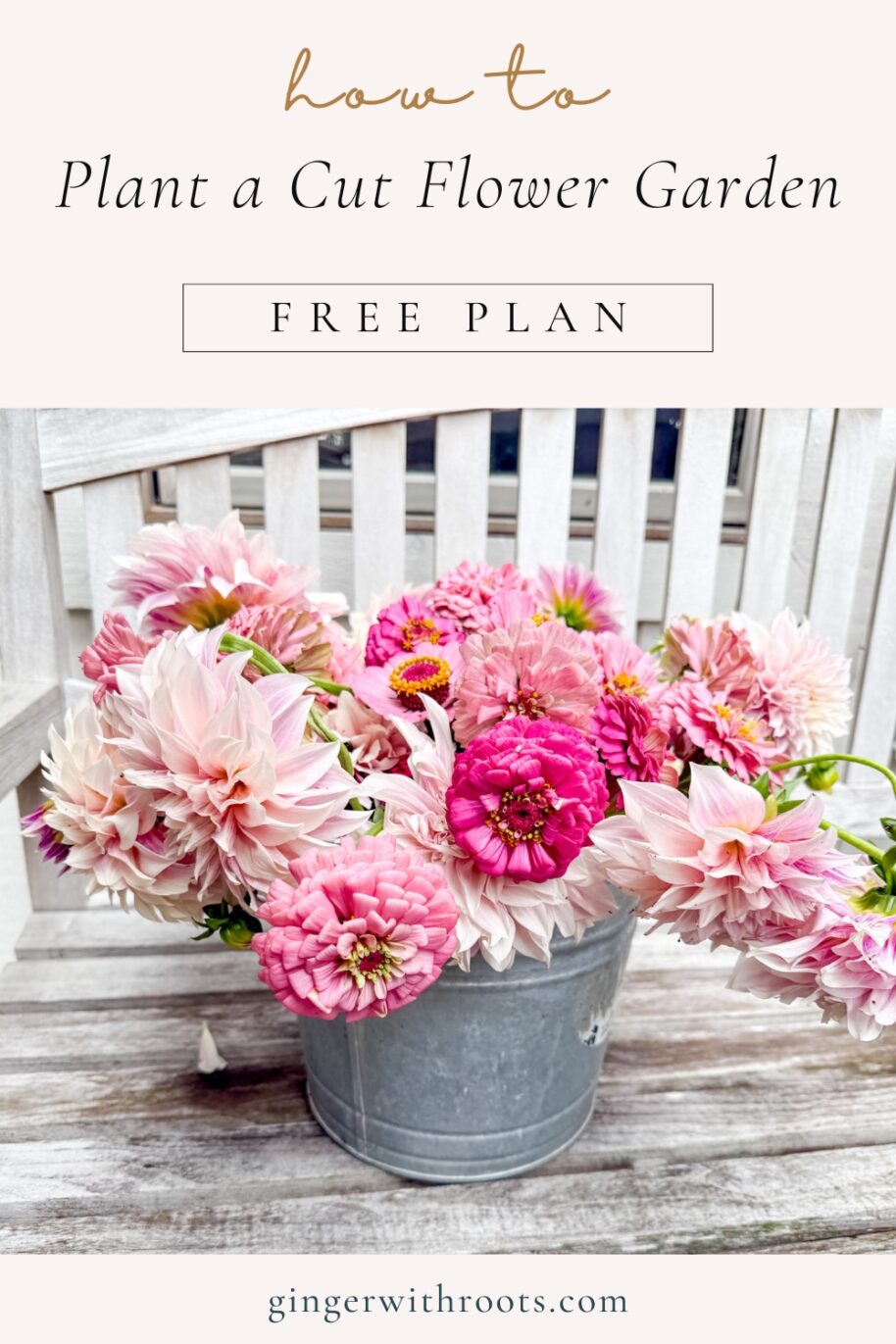
Looking for some garden planning ideas? Read my post about Beginner Cut Flower Garden complete with flower layouts for a 4’x8′ raised bed.




I am a first time gardener and I am so excited to have found some help on keeping a garden journal. I now have a place to start in recording my garden. Thank you!
Welcome to the wonderful world of gardening! You will be so grateful for starting your journal now instead of waiting like most of us did!
I have attempted to keep a garden planner/ journal for several years. There’s been many missteps, procrastinating windows, and down right failures. But every spring, I pull it out, look for past successes, thoughts of improvement, and the challenge to renew my connection with nature. Thanks for your ideas and encouragement.
Agreed! It’s not been the number one priority in my years of gardening because all I want to do is garden, but it really is a valuable tool! Thanks for being here!